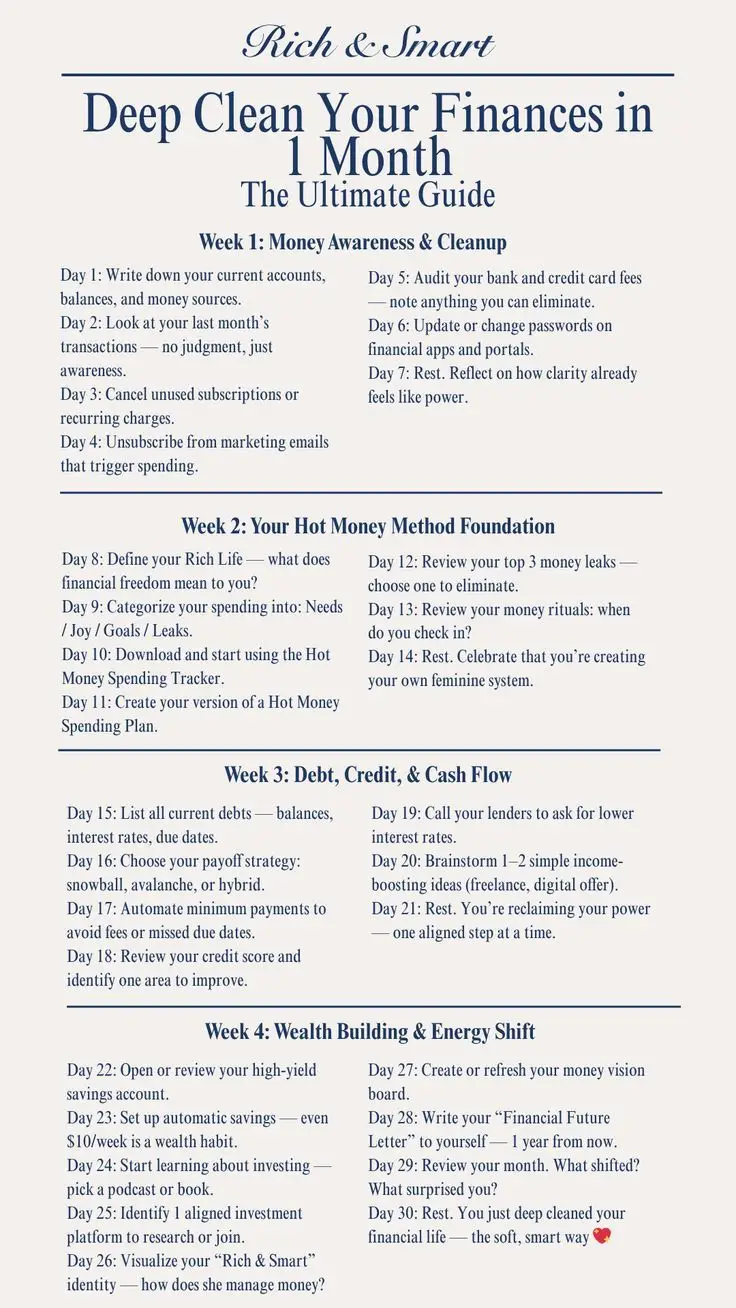
There’s something powerful about a deep clean.
When you declutter your home, you breathe easier. When you clear your inbox, you feel lighter. The same is true for your finances. Most people don’t need more money first — they need clarity, structure, and intentional habits.
This 30-day financial reset is designed to help you “deep clean” your money life step by step. No overwhelm. No shame. Just focused daily actions that build momentum.
Let’s walk through the full month — and how to make it transformative.
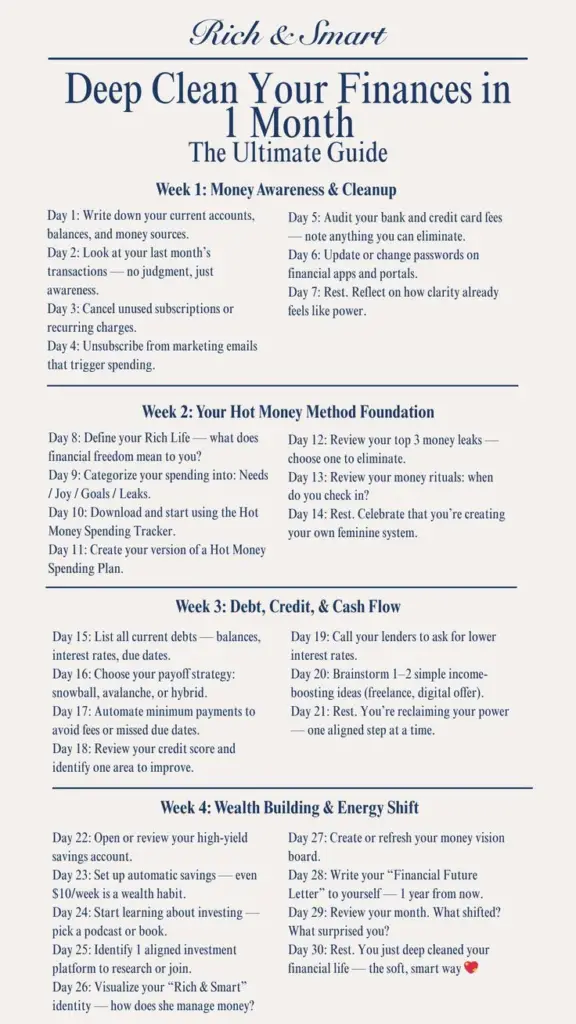
Why a Financial Deep Clean Works
Money stress usually doesn’t come from math.
It comes from:
- Avoidance
- Disorganization
- Leaks you didn’t notice
- Debt without a plan
- Income without direction
A structured 30-day reset works because:
- It turns chaos into visibility
- It replaces guilt with data
- It converts intention into systems
- It builds small wins daily
By the end of the month, you don’t just “know your numbers.” You feel in control.
Week 1: Money Awareness & Cleanup
This week is about clarity — not change.
No drastic decisions. No extreme budgeting. Just awareness.
Day 1: Write Down All Accounts & Balances
List everything:
- Checking accounts
- Savings accounts
- Credit cards
- Loans
- Investment accounts
- Cash
- Side income sources
Most people underestimate or overestimate their situation because they don’t see it in one place.
When it’s written down, it becomes real — and manageable.
Day 2: Review Last Month’s Transactions
Scroll through your bank and credit card statements.
No judgment. Just observation.
Ask:
- Where did my money actually go?
- What surprised me?
- What felt aligned?
- What felt reactive?
Awareness is the first shift.
Day 3: Cancel Unused Subscriptions
Streaming services.
App subscriptions.
Gym memberships.
Forgotten trial charges.
Even $15–$30 per month adds up.
Canceling even two subscriptions could free $300–$500 per year.
This is your first “money leak” plug.
Day 4: Unsubscribe From Spending Triggers
Marketing emails are engineered to activate emotion.
Sales.
Flash deals.
Limited offers.
Buy-now pressure.
Unsubscribe from brands that tempt you into impulse purchases.
Protect your focus like you protect your wallet.
Day 5: Audit Bank & Credit Card Fees
Look for:
- Maintenance fees
- ATM fees
- Overdraft charges
- High interest rates
Many banks will waive fees if you ask.
Financial deep cleaning includes removing unnecessary friction.
Day 6: Update Passwords on Financial Apps
Security is wealth protection.
Update passwords for:
- Bank accounts
- Investment platforms
- Payment apps
- Email accounts connected to money
Enable two-factor authentication.
Protecting what you build is part of financial maturity.
Day 7: Rest & Reflect
Pause.
Ask yourself:
- How does clarity feel?
- What surprised me?
- What pattern do I notice?
Clarity often feels like power.
Week 1 is about facing reality — and realizing it’s not as scary as avoidance made it.
Week 2: Your Foundation — Building a Personal Money System
Now that you see your financial life clearly, it’s time to design it intentionally.
Day 8: Define Your “Rich Life”
What does financial freedom mean to you?
Is it:
- Freedom from debt?
- Travel flexibility?
- Owning a home?
- Early retirement?
- Supporting family?
- Peace of mind?
Wealth is personal.
Define it clearly.
Day 9: Categorize Spending
Break your spending into four buckets:
- Needs (housing, food, utilities)
- Joy (dining, hobbies)
- Goals (savings, debt payoff)
- Leaks (impulse spending, unused services)
This helps you cut leaks without cutting joy.
The goal isn’t restriction — it’s alignment.
Day 10: Start a Spending Tracker
Use:
- A spreadsheet
- A notebook
- A budgeting app
Track every expense for 30 days.
Not forever. Just 30 days.
Tracking increases awareness — and naturally reduces overspending.
Day 11: Create Your Personal Spending Plan
Based on your income:
- Decide fixed allocations
- Set savings percentage
- Define weekly spending limits
- Assign every dollar a job
This becomes your system.
A system reduces emotional decision-making.
Day 12: Identify Your Top 3 Money Leaks
Common leaks include:
- Takeout multiple times per week
- Online impulse shopping
- High interest debt
- Unnecessary subscriptions
Choose ONE to eliminate this month.
Small wins build confidence.
Day 13: Review Your Money Rituals
When do you check your finances?
Once a month?
Never?
Only when stressed?
Create a weekly 20-minute money check-in ritual.
Consistency beats intensity.
Day 14: Rest & Celebrate Progress
You’ve created structure.
That’s powerful.
Many people live years without intentional financial design.
You’re different now.
Week 3: Debt, Credit & Cash Flow Control
This week is about strengthening your financial foundation.
Day 15: List All Debts Clearly
Include:
- Balance
- Interest rate
- Minimum payment
- Due date
Clarity removes fear.
Fear grows in vagueness.
Day 16: Choose a Payoff Strategy
Three common strategies:
Snowball:
- Pay smallest balances first.
- Builds psychological momentum.
Avalanche:
- Pay highest interest first.
- Saves more money long term.
Hybrid:
- Mix motivation with math.
Choose the one that fits your personality.
Day 17: Automate Minimum Payments
Automation prevents:
- Late fees
- Credit score damage
- Stress
Automation protects your progress.
Day 18: Review Your Credit Score
Check:
- Score
- Payment history
- Credit utilization
- Errors
Improving credit improves future financial options.
Day 19: Call Lenders
Ask for:
- Lower interest rates
- Hardship options
- Better repayment terms
Many people never ask.
You lose nothing by requesting better terms.
Day 20: Brainstorm 1–2 Income Boosting Ideas
Examples:
- Freelancing
- Consulting
- Digital product
- Tutoring
- Selling unused items
Income growth accelerates everything.
Cost cutting has limits.
Earning doesn’t.
Day 21: Rest & Reflect
Notice how empowered you feel handling debt proactively instead of avoiding it.
You’re building resilience.
Week 4: Wealth Building & Identity Shift
Now that your finances are cleaner and more structured, it’s time to think long-term.
Day 22: Open or Review a High-Yield Savings Account
Emergency savings = stability.
Aim first for:
- $500
- Then $1,000
- Then 3–6 months of expenses
Security reduces financial anxiety dramatically.
Day 23: Set Up Automatic Savings
Even $10–$50 per week builds the habit.
Automation removes the need for willpower.
Consistency builds wealth quietly.
Day 24: Start Learning About Investing
Read.
Listen to a podcast.
Watch educational content.
You don’t need to invest immediately.
You need understanding.
Financial literacy compounds like money does.
Day 25: Identify an Investment Platform to Research
Look into:
- Brokerage accounts
- Retirement accounts
- Index funds
- ETFs
The goal is awareness, not impulsive investing.
Day 26: Visualize Your Financial Identity
Ask:
- How does my financially confident self behave?
- How does she/he make spending decisions?
- How often do they check finances?
- How do they respond to setbacks?
Identity drives behavior.
If you see yourself as financially disciplined, you act accordingly.
Day 27: Create a Money Vision Board
Add images of:
- Debt freedom
- Travel
- Home ownership
- Retirement lifestyle
- Financial independence
Visualization increases motivation.
Day 28: Write a Letter to Your Future Self
Write from today to one year ahead.
Describe:
- Where you’ll be financially
- How you’ll feel
- What habits you maintained
This strengthens commitment.
Day 29: Review the Month
Ask:
- What changed?
- What surprised me?
- What habit felt hardest?
- What felt empowering?
Reflection locks in growth.
Day 30: Rest & Acknowledge Your Progress
You didn’t just budget.
You:
- Organized
- Protected
- Planned
- Reduced leaks
- Built systems
- Increased awareness
- Strengthened discipline
That’s transformation.
What Happens After the 30 Days?
The goal isn’t perfection.
The goal is:
- Clarity
- Structure
- Awareness
- Momentum
After this month, continue:
- Weekly money check-ins
- Monthly spending reviews
- Quarterly financial goal adjustments
- Ongoing income development
Wealth building is not dramatic.
It’s consistent.
Final Thoughts: The Real Deep Clean
A financial deep clean isn’t about cutting everything joyful.
It’s about:
- Aligning spending with values
- Removing unnecessary leaks
- Automating protection
- Creating space for growth
When money feels organized, life feels lighter.
And the most powerful shift isn’t in your bank balance.
It’s in your confidence.
You’re no longer reacting.
You’re directing.
That’s what being truly “rich and smart” means.
