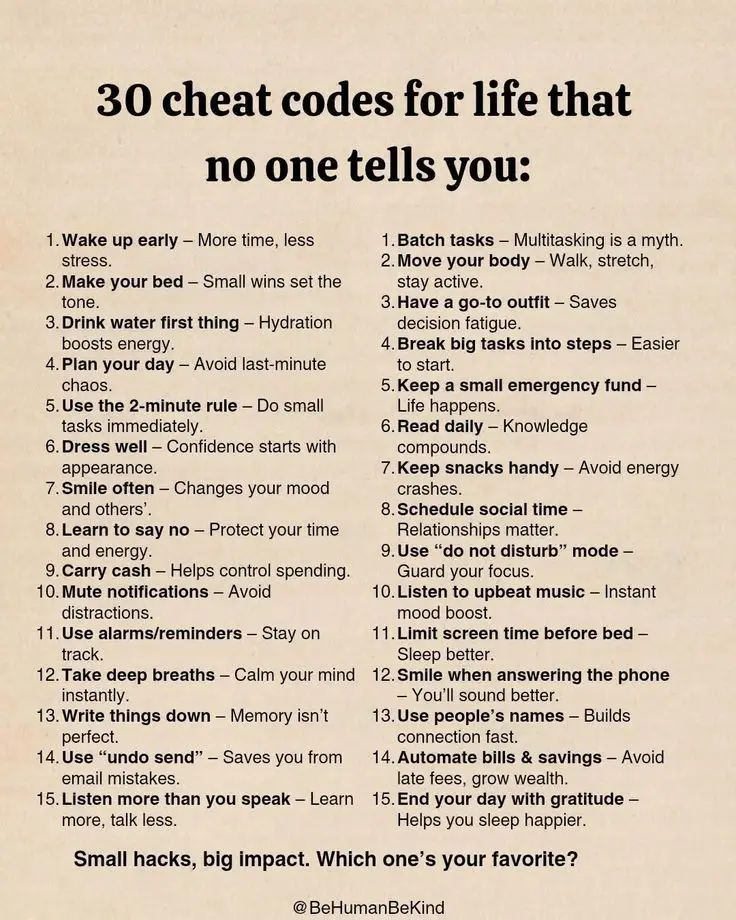
Life doesn’t come with a manual. Most of what truly improves our days isn’t complicated, expensive, or dramatic — it’s small, consistent actions that quietly compound over time. The image you shared lists 30 “cheat codes” for life — simple habits that make everything feel more manageable.
These aren’t shortcuts in the traditional sense. They’re awareness tools. Tiny shifts in behavior that create massive improvements in stress, productivity, happiness, relationships, and finances.
Let’s break them down in detail and explore why they work — and how you can apply them in real life.
1. Wake Up Early – More Time, Less Stress
Waking up early isn’t about joining a 5 a.m. club just to post about it. It’s about creating margin. When you wake up before the world demands your attention, you gain control over your morning instead of reacting to it.
Early mornings allow time to think, plan, stretch, read, or simply breathe. Instead of rushing into your day, you ease into it. That difference alone lowers stress dramatically.
You don’t need to wake up at 4 a.m. Just 30–60 minutes earlier than usual can change everything.
2. Make Your Bed – Small Wins Set the Tone
Making your bed sounds trivial. It’s not.
It’s the first completed task of the day. A small win. And small wins create momentum. When you start your day with order, your brain subconsciously seeks more order.
Plus, coming home to a tidy space improves your mood more than you realize.
3. Drink Water First Thing – Hydration Boosts Energy
Before coffee. Before scrolling. Before emails.
Your body wakes up dehydrated. A glass of water jumpstarts your metabolism, improves mental clarity, and supports digestion.
It’s one of the easiest energy upgrades available — and it’s free.
4. Plan Your Day – Avoid Last-Minute Chaos
If you don’t plan your day, someone else will.
Planning doesn’t require an elaborate system. Just write down 3–5 key tasks you must complete. That clarity removes decision fatigue and reduces overwhelm.
When you know what matters today, you stop reacting to everything that doesn’t.
5. Use the 2-Minute Rule – Do Small Tasks Immediately
If something takes less than two minutes, do it now.
Reply to that email. Put the dish away. Send the message.
Small tasks pile up quickly. Handling them immediately prevents mental clutter and builds discipline.
6. Dress Well – Confidence Starts with Appearance
This isn’t about expensive clothes. It’s about intention.
When you dress with care — even casually — you signal to yourself that you matter. That confidence shows up in how you speak, walk, and make decisions.
You don’t need a designer wardrobe. Just wear clean, well-fitted clothes that make you feel capable.
7. Smile Often – It Changes Your Mood (and Others’)
Smiling triggers the release of feel-good chemicals in your brain. Even forced smiles can improve mood.
More importantly, smiling is contagious. It softens conversations and makes you more approachable.
It costs nothing but changes everything.
8. Learn to Say No – Protect Your Time and Energy
Every “yes” to something unimportant is a “no” to something meaningful.
Saying no isn’t selfish — it’s strategic. Protect your calendar and your mental space. You don’t owe access to your energy to everyone.
Boundaries are a form of self-respect.
9. Carry Cash – Helps Control Spending
Swiping a card feels abstract. Cash feels real.
When you physically hand over money, you’re more aware of what you’re spending. That awareness reduces impulse buying.
It’s a psychological trick that improves financial discipline.
10. Mute Notifications – Avoid Distractions
Your phone is designed to steal your focus.
Notifications fragment attention and reduce productivity. Mute non-essential alerts. Check messages on your schedule, not theirs.
Deep focus is a superpower in a distracted world.
11. Use Alarms and Reminders – Stay on Track
Relying solely on memory is inefficient. Use tools.
Set reminders for important tasks, deadlines, workouts, and even breaks. Offloading mental load frees your brain for higher-level thinking.
Smart people don’t try to remember everything. They build systems.
12. Take Deep Breaths – Calm Your Mind Instantly
Stress activates your fight-or-flight response. Slow breathing reverses it.
Try this: inhale for 4 seconds, hold for 4, exhale for 6. Repeat five times.
Within minutes, your heart rate slows, and clarity returns.
13. Write Things Down – Memory Isn’t Perfect
Your brain is for ideas, not storage.
Writing things down reduces anxiety because you no longer fear forgetting. It also improves clarity and problem-solving.
Whether it’s a notebook or digital app, capture thoughts externally.
14. Use “Undo Send” – Avoid Email Regret
Emotion and email don’t mix well.
That short delay feature saves relationships and reputations. Give yourself a few seconds to rethink a message before it goes out.
Tiny buffer. Massive impact.
15. Listen More Than You Speak – Learn More, Talk Less
People reveal everything when you truly listen.
Active listening builds trust, deepens relationships, and increases influence. When you speak less, your words carry more weight.
Listening is underrated leadership.
Productivity and Energy Boosters
16. Batch Tasks – Multitasking Is a Myth
Multitasking reduces efficiency and increases mistakes.
Instead, group similar tasks together. Answer emails in one session. Make calls in one block.
Your brain performs better when it stays in one mode.
17. Move Your Body – Walk, Stretch, Stay Active
You don’t need an intense workout every day.
A 15-minute walk clears mental fog. Stretching improves posture and reduces tension. Movement boosts mood, creativity, and energy.
Motion changes emotion.
18. Have a Go-To Outfit – Save Mental Energy
Decision fatigue is real.
Simplifying small decisions (like what to wear) preserves mental energy for bigger ones. Many successful people repeat outfits for this reason.
Fewer decisions. More focus.
19. Break Big Tasks into Steps – Easier to Start
Overwhelm comes from vagueness.
“Write report” feels heavy.
“Write introduction paragraph” feels doable.
Clarity reduces procrastination.
20. Keep a Small Emergency Fund – Life Happens
Financial stress drains mental energy.
Even a small emergency fund creates security. It reduces panic when unexpected expenses appear.
Peace of mind is priceless.
21. Read Daily – Knowledge Compounds
Reading 10 pages a day equals 3,650 pages a year — roughly 12 books.
Knowledge compounds like money. The insights you gain today may transform decisions years later.
Consistent learning builds quiet confidence.
22. Keep Snacks Handy – Avoid Energy Crashes
Hunger affects mood and decision-making.
Healthy snacks prevent crashes that lead to irritability or poor choices. Stable blood sugar equals stable focus.
23. Schedule Social Time – Relationships Matter
Connection isn’t automatic. It requires intention.
Schedule coffee dates, family calls, or friend meetups. Relationships are one of the strongest predictors of happiness.
Success feels empty alone.
24. Use “Do Not Disturb” Mode – Guard Your Focus
Protect blocks of uninterrupted work time.
Silence your phone and commit fully to one task. You’ll finish faster and with better quality.
Deep work creates real progress.
25. Listen to Upbeat Music – Instant Mood Boost
Music shifts emotional states quickly.
Create a playlist that energizes you. Use it before workouts, difficult tasks, or when motivation dips.
Sound influences state.
26. Limit Screen Time Before Bed – Sleep Better
Blue light disrupts melatonin production.
Reducing screen time at night improves sleep quality, which improves everything else — mood, productivity, patience, health.
Good sleep is a multiplier.
27. Smile When Answering the Phone – You’ll Sound Better
People can hear your facial expression.
Smiling while speaking changes tone, making you sound warmer and more confident.
Tiny trick. Big communication upgrade.
28. Use People’s Names – Builds Instant Connection
A person’s name is powerful.
Using it respectfully makes conversations more personal and memorable. It signals attention and care.
Connection builds opportunity.
29. Automate Bills and Savings – Avoid Fees, Grow Wealth
Automation removes reliance on willpower.
When savings happen automatically, you don’t “miss” the money. Consistency builds wealth quietly.
Systems beat motivation.
30. End Your Day with Gratitude – Sleep Happier
Before sleeping, think of three things you’re grateful for.
Gratitude shifts focus from what’s lacking to what’s working. It reduces anxiety and improves emotional resilience.
You fall asleep lighter.
The Real Secret: Consistency
None of these habits are dramatic.
That’s the point.
The biggest life changes rarely come from grand gestures. They come from small, repeatable actions done consistently over time.
You don’t need to implement all 30 at once. Start with three. Master them. Then add more.
Life doesn’t improve overnight — but it does improve daily.
Final Thoughts
These “cheat codes” aren’t hacks in the sneaky sense. They’re awareness tools. Tiny shifts that help you manage your energy, time, money, and relationships more intentionally.
Small habits compound.
Tiny disciplines create freedom.
Simple actions build extraordinary lives.
The question isn’t which one is best.
The real question is:
Which one will you start today?
